
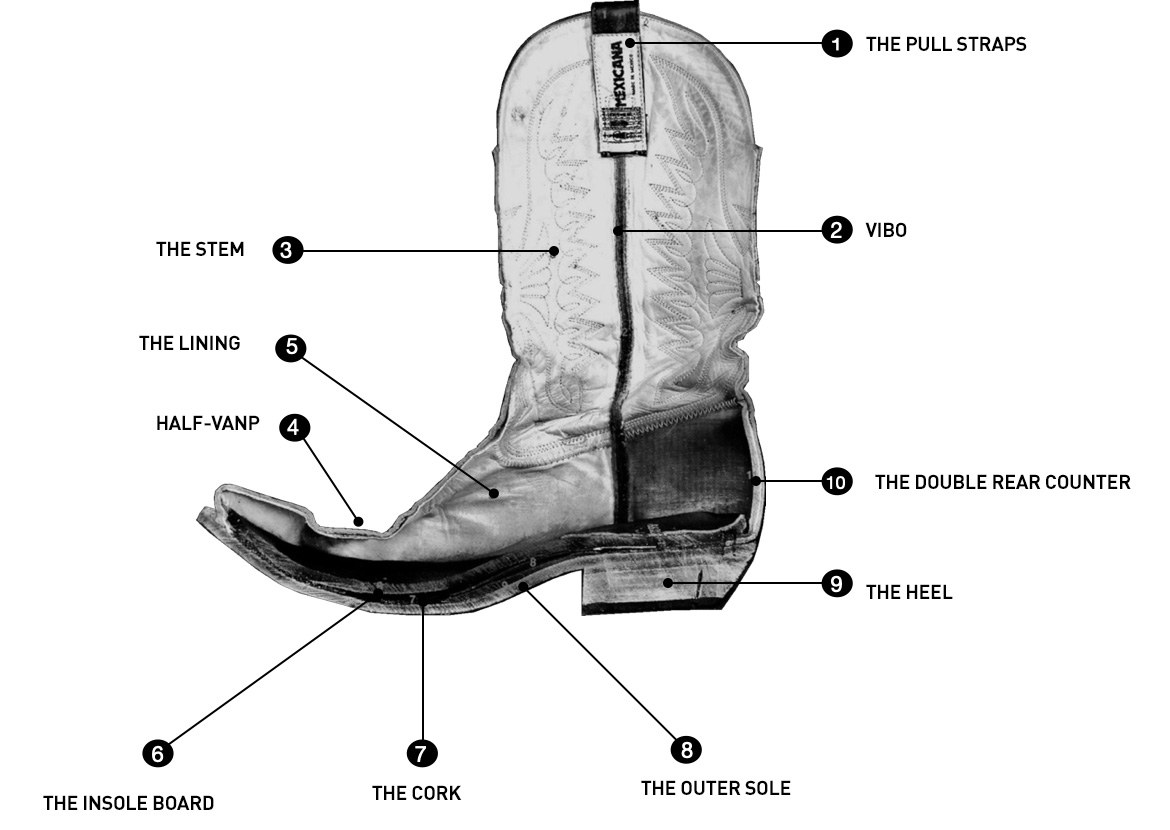
Anatomy of a boot

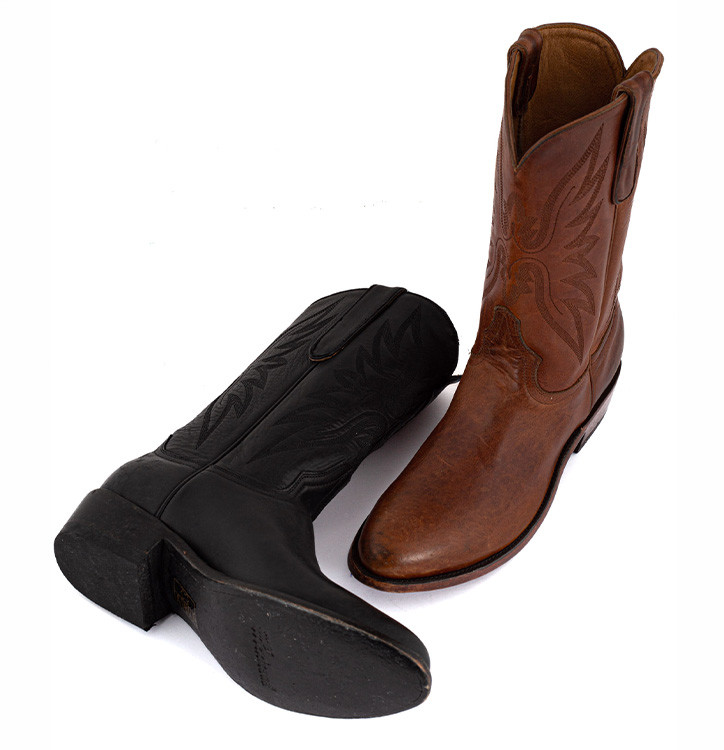
On a wooden last, previously designed and then sculpted by a pattern maker (which can be modified according to the desired boot shapes), the leather is placed and nailed directly onto the last in order to secure the assembly. To allow the leather to perfectly follow the shape, Mexicana perpetuates the Mexican traditions of lasting by wetting the hides. Many subsequent steps follow, some of which we will discover through the lateral cross-section of the boot on the left-hand page.

The pull straps or tabs

This leather pull tab, into which the fingers are slipped to make the boot easier to put on, is called a pull strap

The cork

A shock absorber and moisture barrier, cork is inserted between the inner and outer soles. It is essential to your comfort and gives the stride much greater flexibility.

Vibo or cowhide leather strip

Refers to the inner open seam running along the entire profile of the boot, reflecting the quality and traditional techniques specific to the Mexicana brand. This operation is carried out using a Landis machine.

The walking sole or outer sole

This piece of hard leather, selected from premium-quality hides, is doubly reinforced with a plastic material called CELASTIC. It keeps the heel in place and prevents the shaft from collapsing. A boot that ages well therefore depends on a high-quality counter. This unique process is specific to the MEXICANA brand.

The stem

Here made from cowhide leather, using sewing machines and combinations of coloured threads, the shafts are first embroidered and decorated flat. It is thanks to the skill of the embroiderer’s hands that Mexicana shafts have the relief so prized by connoisseurs.

The double rear counter

A shock absorber and moisture barrier, cork is inserted between the inner and outer soles. It is essential to your comfort and gives the stride much greater flexibility.

Half-vamp

This is the widest part of the boot foot, the area where the foot bends.

The heel

It is made up of layers of leather glued together. A craftsman is responsible for calibrating the leather layers, assessing the thickness of each one by holding them between his teeth to check their quality. In this way, he ensures the correct height of each heel.

The lining

Made from full-grain leather, it will only improve with time and will carry the detailed imprint of your foot’s anatomy for life.

The insole board or inner sole

This is the name given to the first sole around which the various construction elements of the boot are assembled. This leather sole takes the shape of the sole of your foot and ensures maximum comfort. It is assembled with the lining and a small leather strip called the “RIP” by means of a vertical stitch, the “WELT stitch” (not visible in the photo), which will then connect it by stitching to the outer sole.

We have deliberately summarized what amounts to at least 175 distinct operations required to craft a pair of ornate Mexicana boots, making them truly exceptional. Far more than a conventional pair of shoes, western boots belong to the world of valuable objects, bold and original creations imagined over time by artistic and inventive people. They enhance colourful, unconventional profiles, convey a state of mind, a free spirit, and a passionate invitation to express one’s character or personality: wearing Mexicana means the assurance of stepping into solid, extraordinary boots whose reputation has elevated the brand to the ranks of the world’s greatest western bootmakers.

Loading...
Back to top
